
11 August 2026
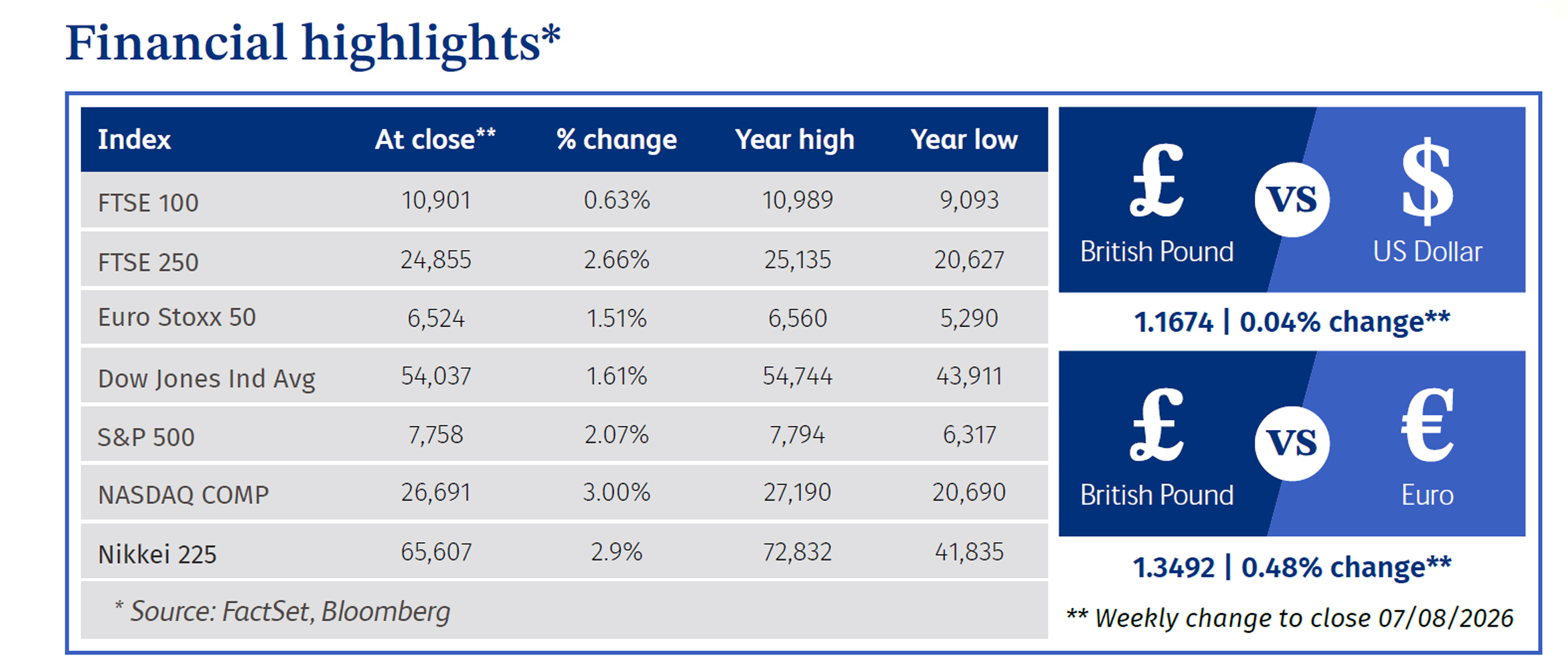
Last week, Purchasing Manager’s Index (“PMI”) mixed signals pointed to a modest UK economic recovery. Whilst UK business activity saw a first rise in three months, driving the broader economy up, manufacturing and construction remain laggards, meaning that sustainable growth will depend on whether supply chain and inflation pressures continue to moderate. However, the geopolitical reasons are threatening this, as EY points out that the prolonged closure of the Strait of Hormuz could cause inflation to double, risking a UK recession. The recent heatwaves are also a threat, hampering retail footfall in July and potentially disrupting supply chains and causing prices to spike. The Bank of England (“BoE”) is also facing some scrutiny over its active quantitative tightening (“QT”) strategy, as the market is getting anxious over the valuation losses which ultimately strain public finances, creating a headwind to rate expectations and overall market sentiment.
Fiscally, Britain’s fiscal room for manoeuvre is shrinking as public debt breaches £3 trillion. Spending cuts ahead of the expected October budget have been ordered by the Chancellor of the Exchequer, John Healey, across government departments. Officials are simultaneously considering tweaks to the fiscal rules. The goal is to allow an extra £9 billion in annual borrowing for regional infrastructure. Political calls for a windfall tax on lenders resurfaced after banks posted £29.2 billion in first-half profits, which the financial sector is pushing back hard. Fresh levies would severely damage London’s competitive standing against international rivals, according to Citigroup Chief Executive, Jane Fraser.
In the markets, investor confidence in UK assets remains low with capital flight accelerating in July as investors pulled a record £1.6 billion from domestic equity funds spooked by potential capital gains tax (“CGT”) changes. Primary market activity is offering little relief with just seven listings that have raised £557 million in 2026. Private equity exit routes are effectively blocked by this drought. A provisional ruling was also issued by the Competition and Markets Authority (“CMA”) against discount grocers, Aldi and Lidl, which are now prevented from using restrictive land agreements against rivals. Buyers remain waiting for clearer policy direction, keeping overall sentiment subdued.
Across the pond, US equities rallied to another set of record highs, driven by strong outperformance in technology, software and materials, while energy and defensive sectors lagged. Market sentiment found an anchor in exceptionally strong second-quarter earnings. Mega-cap technology and artificial (“AI”) names led the charge. Long-term bond yields pulled back following stable government refunding guidance causing Treasuries to strengthen. Gold also rose sharply, and crude oil dropped within the commodities space. The economic data revealed a conflicting outlook though, as an unforeseen decline in non-farm payrolls sparked anxieties regarding the labour market, although expanding manufacturing activity provided a counterbalance.
In the housing market, speculation is mounting that the government may revive the Help to Buy scheme to support first-time buyers, despite official denials of an imminent relaunch. The ongoing review was acknowledged by Housing Minister Matthew Pennycook. Whitehall increasingly acknowledges that current housebuilding stimulus efforts are inadequate. Given that the legacy programme previously generated £2 billion in revenue, a potential revival is gaining both political and financial support.
Fresnillo, a precious metals miner producing silver and gold across multiple operations, saw its shares surge 15.72% last week to close at 2,803 pence per share, as investors celebrated first half profits nearly tripling, driven by rising precious metal prices. Revenues climbed nearly 75%. The company doubled its dividend payout to shareholders as a result. Soaring silver and gold prices far outweighed operational headaches. This created overwhelmingly positive market sentiment. Actual production fell and mining expenses rose. An exceptional financial performance was still delivered by the massive price rally. Strong metals pricing was already expected by the markets. The sheer scale of the overperformance gave investors plenty of reason to buy in.
Endeavour Mining, a major gold producer operating several large mines across West Africa, had its shares jump 14.88% to 4,046 pence per share after great half-year results and a rising gold market fuelled strong buying enthusiasm. A record $761 million in free cash flow was generated by the company. Investor confidence saw a massive boost. Corporate debt was completely wiped out. Shareholders were rewarded with $301 million through buybacks and dividends. Solid operational delivery was compounded by rising gold prices. This gave sentiment a further lift. Production remains exactly on track for the year. Operating in West Africa carries political and cost risks. Investors rallied behind the firm anyway. The cash-rich balance sheet, record payouts, and promising organic growth pipeline attracted strong support.
IG Group, an online platform providing financial trading services to retail investors, had a disappointing week after shares dropped 8.01% to 1,343 pence per share, as a surprise acquisition announcement rattled market confidence. An ongoing £125 million share buyback was paused by management. The funds will instead cover a $1.3 billion takeover of US prediction market operator Underdog. Investor mood quickly soured. Regulatory uncertainty surrounding US sports betting laws scared the market. The dilution caused by issuing new shares added heavily to these fears. Doubling its US revenue could transform IG into a higher-growth business. Some analysts argue this specific point. Shareholders instead focused elsewhere. Elevated expansion risks and the immediate loss of buyback support drove the negative reaction.

Market Commentary prepared by Walker Crips Investment Management Limited.
This publication is intended to be Walker Crips Investment Management's own commentary on markets. It is not investment research and should not be construed as an offer or solicitation to buy, sell or trade in any of the investments, sectors or asset classes mentioned. The value of any investment and the income arising from it is not guaranteed and can fall as well as rise, so that you may not get back the amount you originally invested. Past performance is not a reliable indicator of future results. Movements in exchange rates can have an adverse effect on the value, price or income of any non-sterling denominated investment. Nothing in this document constitutes advice to undertake a transaction, and if you require professional advice you should contact your financial adviser or your usual contact at Walker Crips. Walker Crips Investment Management Limited is authorised and regulated by the Financial Conduct Authority (FRN:226344) and is a member of the London Stock Exchange. Registered office: 128 Queen Victoria Street, London, EC4V 4BJ. Registered in England and Wales number 4774117.


Important Note
No news or research content is a recommendation to deal. It is important to remember that the value of investments and the income from them can go down as well as up, so you could get back less than you invest. If you have any doubts about the suitability of any investment for your circumstances, you should contact your financial advisor.

The value of investments can fall as well as rise. Investors may get back less than invested. Past performance is not a reliable indicator of future results.
The value of investments can fall as well as rise. Investors may get back less than invested.