26 February 2026
This article is the second in a short series from James Richards, Investment Director at Walker Crips Investment Management, sharing his investment philosophy and the principles that underpin how he manages client portfolios. In these pieces, James explores some commonly held beliefs about investing and explains why long-term outcomes often depend less on fashionable ideas and more on disciplined investment thinking and practical financial planning.
Our investment philosophy of Protect and Compound is a simple one to explain – Protect capital in falling markets and Compound the growth in real terms over the long-term – but requires diligent, continuous work. We believe that buying what we consider to be quality investments will hold up in the bad times and prosper in the good. We have a strong process that is repeatable, allowing both consistency and reassurance in times of stress. I think back to Covid-19 as a great example of this when the market fell precipitously for a couple of days and there were calls to “sell everything”. Apart from the fact there was not the liquidity in the market to allow this, it would have been herd mentality and not good long-term thinking. To paraphrase Warren Buffet, if you liked an investment at £10 and it has fallen to £8, you should like it a whole lot more, not be selling it.
The military are drilled not to look slick on parade, but as a way of installing togetherness and an ability to keep calm and know what to do in the heat of battle, a strong investment process works in a similar way. Unlike the military, we try to install a flat and meritocratic structure which allows healthy debate. No one is too junior to have an opinion nor too senior not to be challenged. We have recently installed the Japanese culture of asking the most junior colleagues to speak first in a meeting as this hopefully allows them to give their honest opinion rather than feel they have to fall in line with seniors who have already made their mind up.
When looking for new investments, a key stage of our due diligence process is to measure the investment against our Great Eight Principles of Fund Management. We do not expect every investment to get ‘8 out of 8’ but it is unlikely for a fund that is only aligned to 3 or 4 of our principles to make it into our client portfolios. Importantly, past (and particularly recent) performance does not feature as one of the principles. This is because one can easily be swayed by good recent performance and forget this may be cyclical or non-repeatable. The fundamental data of the underlying businesses is however reviewed and critiqued in great detail. High profit margins; low debt ratios; and high (or rising) returns on capital are key characteristics we look for when considering if an investment meets our Quality criteria.
Our focus on high quality companies that can survive in times of economic hardship and then come out stronger and prosper in the good times, will not always be ‘flavour of the month’ as these types of companies are often called “boring” rather than the latest fad that goes to the moon, but then falls back to earth just as quickly. This preference may seem dull, but should result in more predictable growth than an index that is effectively a momentum call – i.e. we like the tortoise over the hare.
Einstein called compounding “the 8th Wonder of the World”, and it is achieved through long holding periods in quality investments. Which asset classes or criteria make up that definition of quality will evolve, but the philosophical North Star remains the goal.
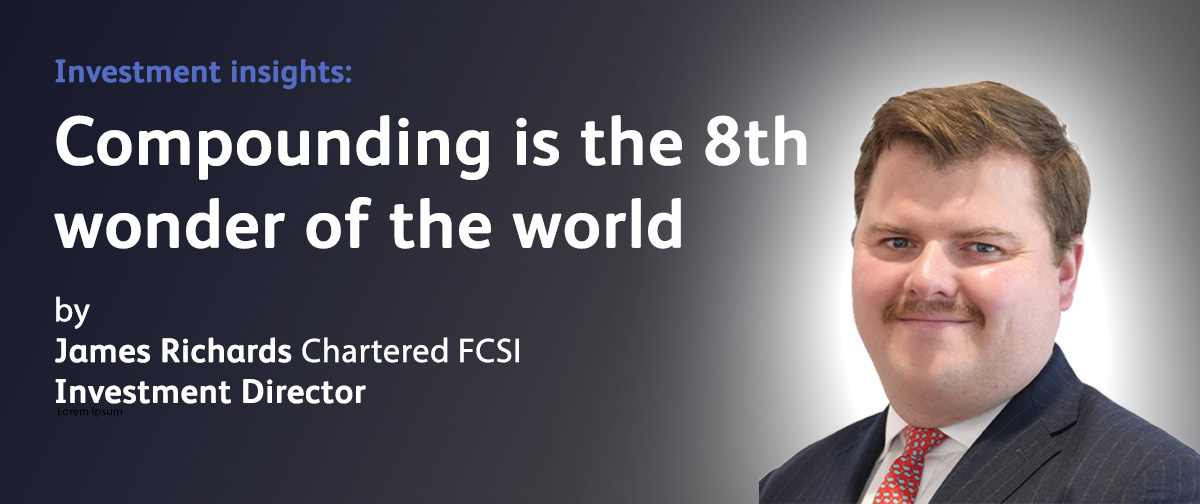
James Richards, Chartered FCSI
Investment Director
Glossary of Terms
Compounding: In financial terms, compounding is the process where the returns on an investment (interest, dividends, or capital gains) are reinvested to generate their own returns over time. Often described as "interest on interest," it transforms a linear growth pattern into an exponential one as the investment "snowballs".
Dividend yield: A financial ratio that shows how much a company pays out in dividends each year relative to its stock price. It is expressed as a percentage.
Gilt: A bond issued by the UK government. They are generally considered lower-risk investments because they are backed by the government.
Total return: The overall return on an investment, combining both capital appreciation (the increase in share price) and any dividends or interest received.
Important information
This article is intended to be Walker Crips Investment Management's own commentary on markets. It is not investment research and should not be construed as an offer or solicitation to buy, sell or trade in any of the investments, sectors or asset classes mentioned. The value of any investment and the income arising from it is not guaranteed and can fall as well as rise, so that you may not get back the amount you originally invested. Past performance is not a reliable indicator of future results. Movements in exchange rates can have an adverse effect on the value, price or income of any non-sterling denominated investment. Nothing in this document constitutes advice to undertake a transaction, and if you require professional advice you should contact your financial adviser or your usual contact at Walker Crips. Walker Crips Investment Management Limited is authorised and regulated by the Financial Conduct Authority (FRN:226344) and is a member of the London Stock Exchange. Registered office: 128 Queen Victoria Street, London, EC4V 4BJ. Registered in England and Wales number 4774117.


Important Note
No news or research content is a recommendation to deal. It is important to remember that the value of investments and the income from them can go down as well as up, so you could get back less than you invest. If you have any doubts about the suitability of any investment for your circumstances, you should contact your financial advisor.

The value of investments can fall as well as rise. Investors may get back less than invested. Past performance is not a reliable indicator of future results.
The value of investments can fall as well as rise. Investors may get back less than invested.